
SPECIAL EDUCATIONAL NEEDS
Coombe Wood School is ambitious for all our pupils and we believe that there is no ceiling on being committed to providing a supportive and inclusive learning environment, giving every young person the opportunity to fulfil their potential now, and in the future.
The leaders at Coombe Wood School are leaders for all pupils, enabling our teachers to be teachers of all pupils. Coombe Wood School is committed to distributed leadership to secure the best possible provision and outcomes for pupils with special educational needs. We have the same ambition for all our pupils, and recognise the importance and impact of prioritising our responsibilities to pupils with special educational needs.
We work in partnership with pupils and their families in identifying and providing for special educational needs. Where appropriate, we also work in partnership with other agencies. We recognise the importance of communication being inclusive, accessible and culturally sensitive to achieve effective partnership working.
What does it mean to have a Special Educational Need?
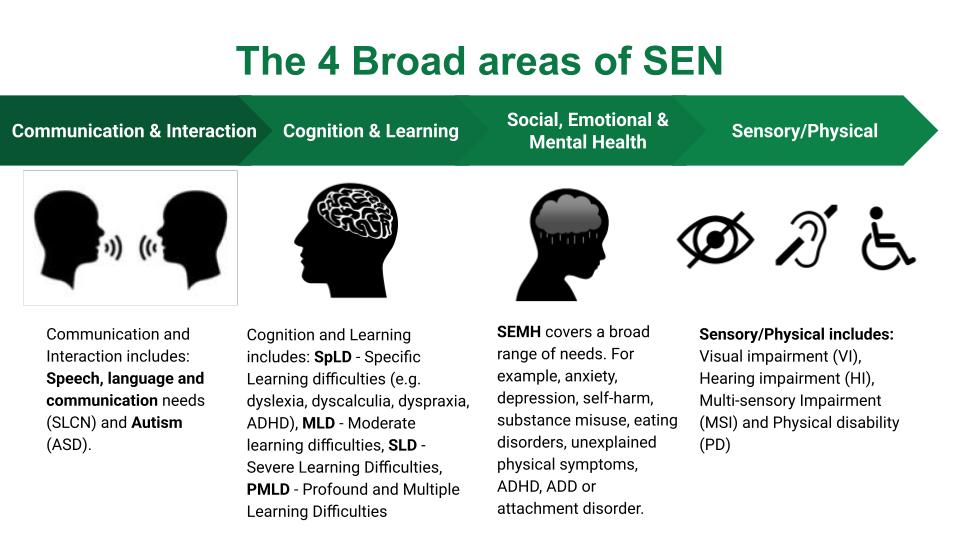
A pupil has SEN if they have a learning difficulty or disability that requires special educational provision to be made for them.
They have a learning difficulty or disability if they have:
-
A significantly greater difficulty in learning than most others of the same age; or
-
A disability that prevents or hinders them from making use of facilities of a kind generally provided for others of the same age in mainstream schools.
Special educational provision is educational or training provision that is additional to, or different from, that made generally for other children or young people of the same age by mainstream schools.
We are committed to ensuring that all students have access to an inclusive mainstream offer alongside their peers, with a focus on maximising children’s access to the broadest possible curriculum offer. As part of our universal provision, all teaching staff receive professional development to build whole-class approaches that support students with a range of learning needs. For example, teachers plan their lessons to ensure that any lesson is sequenced in small steps to reduce cognitive load. Teachers will also build in the use of visuals into their resources to support children’s understanding of key vocabulary and concepts. Teachers make resources available to the students to reference during the lesson to reduce any barriers students face due to their working memory. The ‘CWS lesson structure’ is prioritised for all children so that all children benefit from explicit modelling.
A typical day of support for a student with SEND may look like the following:
-
Arrive at school and be warmly greeted at the door by a member of the senior/pastoral team.
-
Access the quiet area of learning support, to chat with SEND staff and peers before the start of the day and regulate.
-
Attend morning greeting with their peers, receive any missing equipment, check in with their tutor and listen to key messages for the day, prewarning them of any changes.
-
Walk calmly to tutor reading with their peers and start the day listening to an expert member of staff deliver one of the great stories of our time.
-
Attend two morning lessons, being supported by teachers through the core routines providing chunked ,guided practice, in a disruption-free classroom designed with students with SEND at the forefront.
-
Be rewarded by their classroom teacher with achievement points for excellent work and effort.
-
Get a snack from the canteen and spend breaktime with friends either outside or up in the supported Learning Support area. Receive positive signatures on their character card for polite interactions with staff and supporting peers.
-
Attend break time line up, celebrate the school’s values and reset and regulate for a calm start to period 3.
-
Attend period 3 and 4 and continue to build on previous knowledge and skills from the curriculum. Teachers support them through utilising the individual provisions from their student passports. At times, they may receive additional support from a teaching assistant.
-
Attend lunch time, line up and reset and regulate for a calm start to period 5.
-
Attend the final lesson of the day and then celebrate the day's successes, followed by leaving the site calmly with their peers and teacher, potentially attending an after school sports club or homework support.
Our SEND team
|
Ms C Boateng, |
|
|
Mrs N Beattie, |
|
|
Mrs D James, |
|
|
Mrs K Macaskill, |
|
Identification and assessment of children with SEND
Parents/carers are informed when students are added to or removed from the SEN register. When deciding whether special educational provision is required, we will start with the desired outcomes, including the expected progress and attainment, and the views and aspirations of the pupil and their parents/carers. We will use this to determine the support that is needed and whether this can be provided by adapting our core offer, or whether something additional is needed.
We work in close partnership with families and local settings. Many students with special educational needs will therefore be identified through the transition and induction process.
On entry, we assess each student's current skills and levels of attainment, which will build on previous settings and Key Stages, where appropriate. We carry out additional diagnostic tests for any student scoring below a standardised score of 90 in their reading assessment.
Class teachers make regular assessments of progress for all students and identify those whose progress:
-
Is significantly slower than that of their peers starting from the same baseline
-
Fails to match or better the child’s previous rate of progress
-
Fails to close the attainment gap between the child and their peers
-
Widens the attainment gap
-
Demonstrates high levels of dysregulation
In addition, the behaviour, safeguarding, attendance and SEN team meet each week to discuss the needs of our students. This includes progress in areas other than attainment, for example, social needs. Attendance and behaviour data might also be used to identify which pupils require additional support.
Slow progress and low attainment will not automatically mean a pupil is recorded as having SEN.
Where a parent/carer has a concern about their child, parents are asked to speak with the student's head of year or the SENDCO so that appropriate observations and assessments can be undertaken.
Pupil Passport
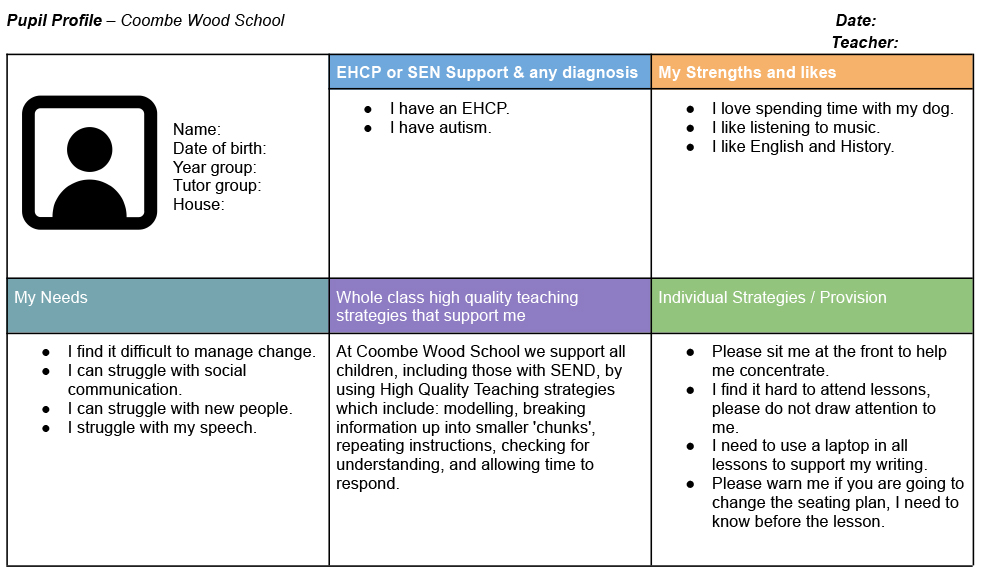
A pupil passport is a regularly reviewed document that contains the needs, strengths and individual strategies for every student with an EHCP or on SEN Support. These are developed in partnership with pupils and their parents/carers. Where appropriate, they might also include strategies recommended by other professionals.
Learning Plan
Some pupils who require more specialised support will have individualised learning plans to complement pupil passports. For example, an individualised learning plan will be used to:
-
Track progress against long-term outcomes in Educational, Health and Care Plans (EHCNAs) for pupils working below age-related expectations.
-
Inform medium-term and daily curriculum planning and provision where children are accessing adapted curriculum pathways.
-
Inform intervention planning.
Universal provision – high quality teaching
Coombe Wood School ensures that a universal provision of high quality teaching is able to address gaps in foundational knowledge and skills. Through evidence-informed classroom routines and a well-planned curriculum, teachers are able to address reading fluency and accuracy, communication and language skills, writing composition and number facts. Furthermore, our carefully selected and sequenced curricula ensure foundational subject-specific knowledge is secure at every step. For some students, effective in-classroom targeted support ensures gaps are identified and tackled quickly through our responsive and adaptive classroom practice.
Curriculum strategies for support
We implement evidence-informed approaches to ensure all students, including those with SEND, can access our world-class curriculum:
-
Consistent routines: All lessons follow the CWS HABITS and lesson structure starting with a retrieval Do Now Quiz (LSQ) and 'Turn and Talk' activities. This consistency reduces cognitive load for SEND students.
-
Retrieval practice: Frequent low-stakes quizzing helps build long-term memory and allows teachers to identify gaps early without the pressure of high-stakes testing.
-
Vocabulary development: Through structured 'Turn and Talks', we explicitly teach vocabulary to strengthen reading comprehension and reduce the 'passivity gap'.
Targeted support
Specific interventions include:
-
Literacy and reading (Sparx Reader, Read Write Inc.)
-
Social skills groups
-
Touch typing
-
Mentoring (internal and external)
-
Numeracy support (Sparx Maths)
-
ELSA (Emotional Literacy Support)
-
Speech and Language (Secondary Language Link)
How do we support social and emotional development?
We take a holistic approach to student wellbeing, fostering confidence and respect:
-
Character Education: All students are encouraged to take part in our character programme and sports teams.
-
Learning Support Base: Available at social times for structured, supervised interaction.
-
Anti-bullying: We have a strict zero-tolerance approach to bullying.
-
ELSA: We have two qualified Emotional Literacy Support Assistants providing daily support.
How do we support transition (primary and post-16?)
Primary to secondary
-
The SENDCO or Inclusion and Transition Manager attends Year 5/6 EHCP reviews.
-
We hold open mornings and specific transition meetings for SEND parents.
-
Additional transition time is provided in the Summer term of Year 6 for SEND students through our Enhanced Transition Mornings.
-
Our team visits feeder primary schools to observe students and discuss strategies with Year 6 teachers.
Preparing for Adulthood (Post-16)
-
College/Sixth Form SENDCOs are invited to Year 11 EHCP reviews.
-
We work with the LA EHCP Coordinator to support independent travel (Developing Determination).
-
We facilitate tours and meetings regarding course entry requirements.
Working with external agencies
Where needs require specialist expertise, Coombe Wood School works closely with Croydon Local Authority to access professional services, including:
-
Educational Psychologists (EP)
-
Speech and Language Therapists (SALT)
-
Occupational Therapy (OT)
-
Advisory teachers
-
CAMHS
-
Social Care
All external involvement is undertaken in full consultation with parents.
Useful links
Teacher Handbook: SEND
With contributions from specialists across the sector, the handbook is a comprehensive resource for teachers and parents to use over time. It brings together practical examples of high-quality teaching - placing focus on removing barriers to learning, getting to know and understand individual learners, and bringing to life the graduated approach. To access this free resource click on the link below and sign up to Whole School SEND:
Whole School SEND Online CPD Units
Free, flexible online learning to help develop inclusive practice.